

Development of the Xitac Tactile Sensor
Xikaku’s mission is to record skilled human work with precise hand, finger and tactile sensing and use it to train robots for specific tasks. In the diagram below we show the general principle of our tacking solution based on a wrist tracker, tactile finger sensors and visual pose recognition using a headset.
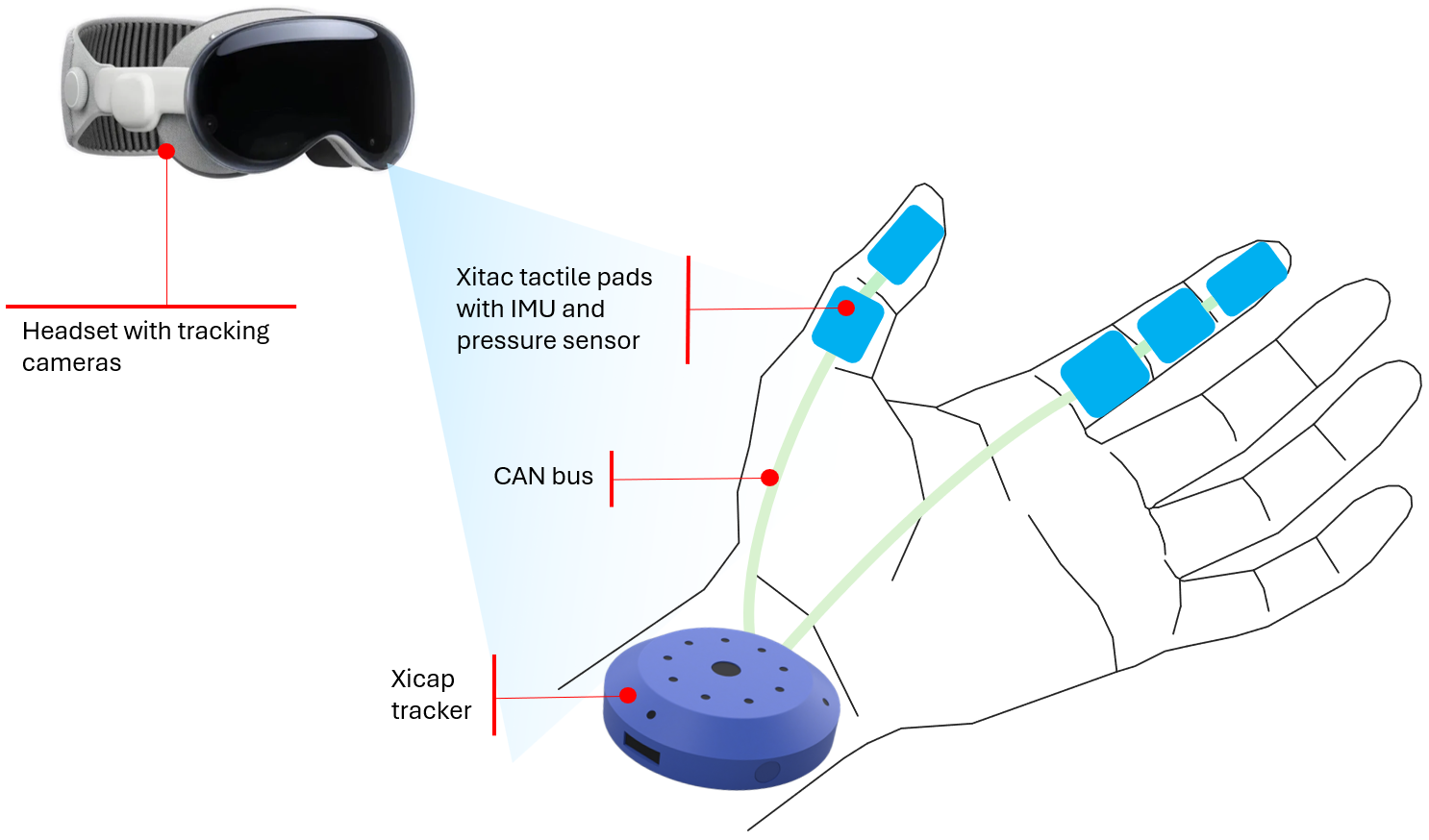
An important part of data collection for humanoid robots is accurately recording hand movements. This is essential for most manipulation tasks that require a high amount of dexterity. Most productive human activities focus rather on deterous and agile upper body and hand motions than movements of the lower body.
A central component of our robotic training solution are the sensors we attach to the fingers of a user. These units are a combination of an IMU - they contain a gyroscope and accelerometer - and a touch sensor. In this article we’ll focus on this tactile sensor.
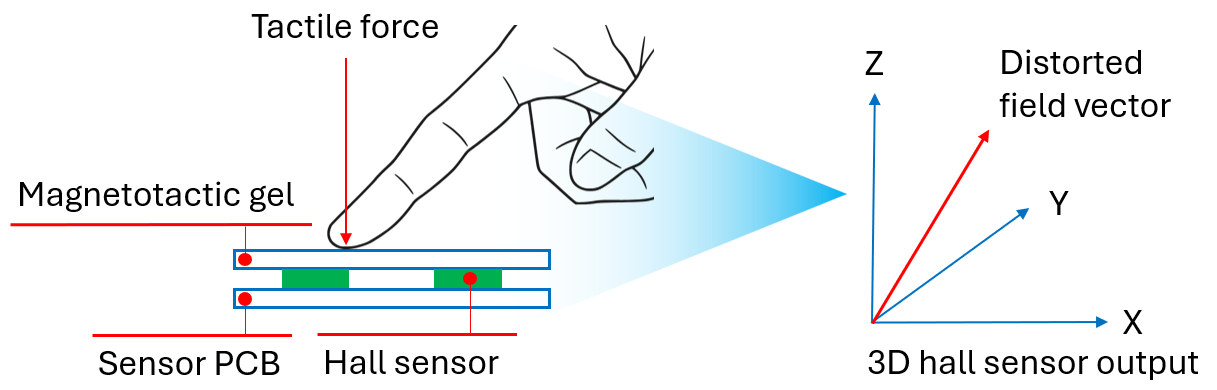
As shown in the image above, we place a layer of magnetotactic gel over an array of 3D hall sensors. Actuating force on the gel deforms the gel and changes the shape of its magnetic flux. The magnetometers measure this distortion of the magnetic field to obtain data on the pressure and shear force acting on the gel.
At a recent AI Tinkerers demo event in LA, we presented a first prototype of the Xitact tactile sensor. See a video of the excellent presentation by my colleagues Lauren Thomann and Justin Li below.
While creating a full glove using the Xitac sensor is still work in progress, we’ve been making important steps towards building the first prototypes of the device and overcome a few unexpected issues. Sourcing and manufacturing the magnetotactic gel turned out to be a bigger challenge than we had initially assumed.
Our current prototype doesn’t yet use a custom made sensor PCB, instead we’re reusing the base board of our LPMS-B2 Bluetooth sensor. The video below shows first results from operating the sensor in this way. This is a very qualitative result, as I press my finger down on the gel you can see the magnetic field graph changing. This confirms that we’re getting a signal from the magnetic gel, but it doesn’t give us the quantitative information we require. For that we need to switch to our custom made PCB that allows us to look at the magnetic flux differential.
Next step will be to attach such a tactile tracker to each finger, and then fuse together optical tracking data from a headset and inertial data from the sensor. This information will then be paired with the tactile information from each tip and sent to our data acquisition and analysis software FusionHub.